
 L-Jet Injectors Aren't Getting Ground, L-Jet Injectors L-Jet Injectors Aren't Getting Ground, L-Jet Injectors |
|
|

|
Porsche, and the Porsche crest are registered trademarks of Dr. Ing. h.c. F. Porsche AG.
This site is not affiliated with Porsche in any way. Its only purpose is to provide an online forum for car enthusiasts. All other trademarks are property of their respective owners. |
|
|

| nmkimosabe |
 Mar 21 2026, 09:44 AM Mar 21 2026, 09:44 AM
Post
#1
|
|
Newbie  Group: Members Posts: 48 Joined: 16-March 25 From: Santa Fe, NM Member No.: 28,660 Region Association: Rocky Mountains  |
After a thorough investigation, it appears that the injectors are not getting ground to fire properly on my 1974 1.8L. Maybe it's an air flow sensor issue but not sure. All the other wiring seems to be okay. I would appreciate any thoughts from the knowledgeable folks on this forum. Thank you.
|
   |

 
|
  |
Replies(1 - 19)
| JeffBowlsby |
Mar 21 2026, 09:58 AM
Post
#2
|
|
914 Wiring Harnesses & Beekeeper Group: Members Posts: 9,221 Joined: 7-January 03 From: San Ramon CA Member No.: 104 Region Association: None 
|
Check the schematic for these circuits. LJet injectors do not ground directly, they go through the resistor pack (look for broken wires) and then to the double relay.
Attached thumbnail(s) 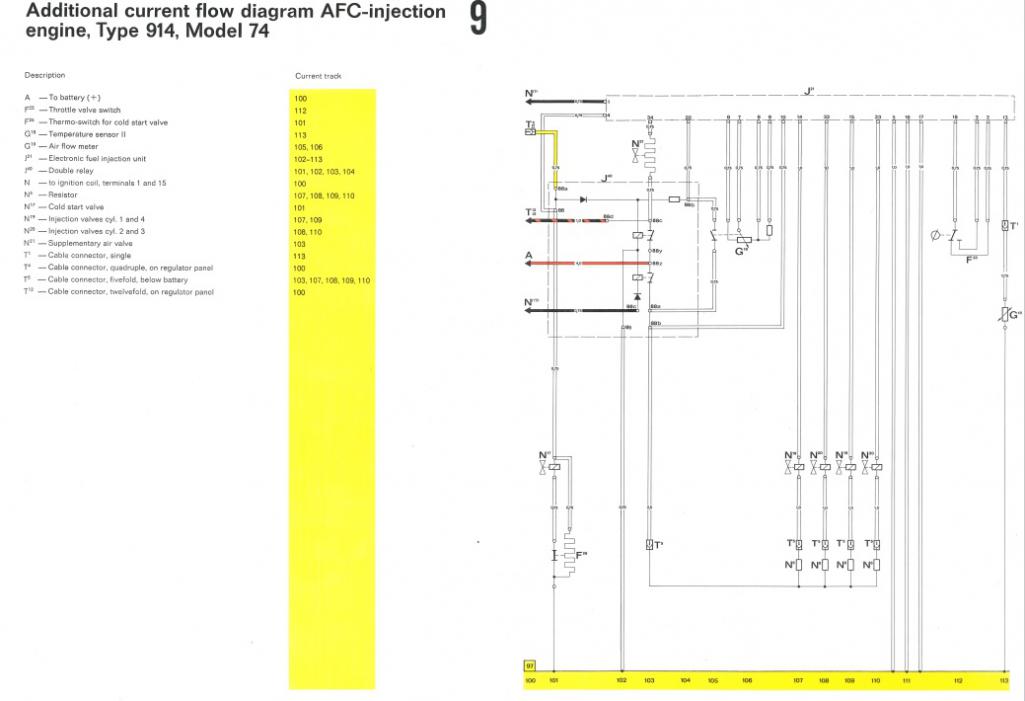
|
 |
|
| fiacra |
Mar 21 2026, 12:15 PM
Post
#3
|
|
Person.Woman.Man.Camera.TV. = MCI Group: Members Posts: 707 Joined: 1-March 19 From: East Bay Region - California Member No.: 22,920 Region Association: Northern California
|
Jeff is the expert here so I'd start with what he recommended. Along those lines, have you tried swapping out the dual relay? I think you said you had the original metal can relay in your car. I'm happy to lend you a NIB dual relay for a test if you wish. You should have a back up relay anyway so you are not wasting money by ordering a new one. However for testing purposes I can get you one quicker than you'll be able to get from JBugs or any other supplier. Happy to put it in today's mail if you get back to me quickly.
|
|
|
|
| nmkimosabe |
Mar 21 2026, 04:19 PM
Post
#4
|
|
Newbie Group: Members Posts: 48 Joined: 16-March 25 From: Santa Fe, NM Member No.: 28,660 Region Association: Rocky Mountains |
QUOTE(fiacra @ Mar 21 2026, 11:15 AM)  Jeff is the expert here so I'd start with what he recommended. Along those lines, have you tried swapping out the dual relay? I think you said you had the original metal can relay in your car. I'm happy to lend you a NIB dual relay for a test if you wish. You should have a back up relay anyway so you are not wasting money by ordering a new one. However for testing purposes I can get you one quicker than you'll be able to get from JBugs or any other supplier. Happy to put it in today's mail if you get back to me quickly. I took your advice earlier this week and bought one per the SKU's and photos you posted. I won't get it until Wednesday, but my mechanic thinks mine if okay. I am also buying another resister pack in case mine is bad. I really appreciate your offer to send me a loaner! I will keep you posted as we solve this issue. Best to you. |
|
|
|
| nmkimosabe |
Mar 21 2026, 04:25 PM
Post
#5
|
|
Newbie Group: Members Posts: 48 Joined: 16-March 25 From: Santa Fe, NM Member No.: 28,660 Region Association: Rocky Mountains |
QUOTE(JeffBowlsby @ Mar 21 2026, 08:58 AM) Check the schematic for these circuits. LJet injectors do not ground directly, they go through the resistor pack (look for broken wires) and then to the double relay. @JeffBowlsby Thanks Jeff for taking the time to send the schematic and your thoughts. I've read many of your articles since I bought this car last Spring. I will print this out and review with my mechanic on Monday and get back to you. We've checked all the wiring, AFM plug and flap, vacuum lines, dual relay, dwell, coil but can't seem to get the injectors to ground and per your article they don't. It has normal fuel pressure and will start briefly at times but won't continue running. I will order a new resistor pack as mine might be the problem. Thanks Jeff. |
|
|
|
| nmkimosabe |
Mar 22 2026, 10:42 AM
Post
#6
|
|
Newbie Group: Members Posts: 48 Joined: 16-March 25 From: Santa Fe, NM Member No.: 28,660 Region Association: Rocky Mountains |
QUOTE(nmkimosabe @ Mar 21 2026, 03:25 PM) QUOTE(JeffBowlsby @ Mar 21 2026, 08:58 AM) Check the schematic for these circuits. LJet injectors do not ground directly, they go through the resistor pack (look for broken wires) and then to the double relay. @JeffBowlsby Thanks Jeff for taking the time to send the schematic and your thoughts. I've read many of your articles since I bought this car last Spring. I will print this out and review with my mechanic on Monday and get back to you. We've checked all the wiring, AFM plug and flap, vacuum lines, dual relay, dwell, coil but can't seem to get the injectors to ground and per your article they don't. It has normal fuel pressure and will start briefly at times but won't continue running. I will order a new resistor pack as mine might be the problem. Thanks Jeff. @JeffBowlsby Jeff---in case you didn't see the earlier thread, the car ran fine and the next day it coughed and died. It will start a few seconds and then stop, Fuel pressure is okay, dwell is at 50 degrees, AFM appears okay but hard to know if the potentiometer is working correctly, negative coil wire is good, don't see any visible wire breaks in harness, dual relay appears fine but need to further test the resistor pack. So the mechanic's response was there is no ground at the injectors, so they are not activating. |
|
|
|
| Superhawk996 |
Mar 22 2026, 11:16 AM
Post
#7
|
|
914 Guru Group: Members Posts: 7,767 Joined: 25-August 18 From: Woods of N. Idaho Member No.: 22,428 Region Association: Galt's Gulch
|
QUOTE(nmkimosabe @ Mar 21 2026, 06:25 PM) I will order a new resistor pack as mine might be the problem. Thanks Jeff. Not trying to start a whole (IMG:style_emoticons/default/stromberg.gif) show but your mechanic should not be guessing and throwing parts at it blindly. If your injectors are not grounding that ought to be addressed. The injectors are switched ground via the ECU. The resistor pack is on the +12v side. The resistor pack has nothing to do with grounding. Has your mechanic verified power to ECU (pin 10) and grounds to the ECU (pins 5,16,17,35) ? |
|
|
|
| nmkimosabe |
Mar 22 2026, 12:55 PM
Post
#8
|
|
Newbie Group: Members Posts: 48 Joined: 16-March 25 From: Santa Fe, NM Member No.: 28,660 Region Association: Rocky Mountains |
QUOTE(Superhawk996 @ Mar 22 2026, 10:16 AM) QUOTE(nmkimosabe @ Mar 21 2026, 06:25 PM) I will order a new resistor pack as mine might be the problem. Thanks Jeff. Not trying to start a whole (IMG:style_emoticons/default/stromberg.gif) show but your mechanic should not be guessing and throwing parts at it blindly. If your injectors are not grounding that ought to be addressed. The injectors are switched ground via the ECU. The resistor pack is on the +12v side. The resistor pack has nothing to do with grounding. Has your mechanic verified power to ECU (pin 10) and grounds to the ECU (pins 5,16,17,35) ? @Superhawk996 I honestly don't know but will ask him about your suggestions on Monday and let you know. I appreciaate your feedback! |
|
|
|
| Superhawk996 |
Mar 22 2026, 01:24 PM
Post
#9
|
|
914 Guru Group: Members Posts: 7,767 Joined: 25-August 18 From: Woods of N. Idaho Member No.: 22,428 Region Association: Galt's Gulch
|
Just beware - lots of mechanics are basically learning about 914’s on your dime while charging $100+ per hour diagnostics.
I realize not everyone wants to work on your car yourself but paying mechanics to guess gets expensive. Jeff Bowlsby has an abundance of tech info on his site including factory documentation and wiring diagrams on L-jet. If your mechanic doesn’t have access to wiring diagrams he’s wasting your time and money. |
|
|
|
| nmkimosabe |
Mar 22 2026, 02:11 PM
Post
#10
|
|
Newbie Group: Members Posts: 48 Joined: 16-March 25 From: Santa Fe, NM Member No.: 28,660 Region Association: Rocky Mountains |
QUOTE(Superhawk996 @ Mar 22 2026, 12:24 PM) Just beware - lots of mechanics are basically learning about 914’s on your dime while charging $100+ per hour diagnostics. I realize not everyone wants to work on your car yourself but paying mechanics to guess gets expensive. Jeff Bowlsby has an abundance of tech info on his site including factory documentation and wiring diagrams on L-jet. If your mechanic doesn’t have access to wiring diagrams he’s wasting your time and money. @Superhawk996 I totally understand. While I'm capable of doing basic maintenance, the electrical components of this car are above my pay grade to be honest. I am slowly learning more as I go and from folks like you on the forum. Appreciate your insights. |
|
|
|
| nmkimosabe |
Mar 31 2026, 05:07 PM
Post
#11
|
|
Newbie Group: Members Posts: 48 Joined: 16-March 25 From: Santa Fe, NM Member No.: 28,660 Region Association: Rocky Mountains |
Here's an update on my 914 and unfortunately, I still can't get it to run. I had the car towed to my mechanic who spent 2 days on it and $600.00 later told me he couldn't figure it out and I wound up towing my car back home. I've done the following:
>Replaced the air flow meter and cleaned the plug >Looked for broken wires throughout the engine bay at least 3 times >Replaced the dual relay >Replaced the resistor pack >Made sure the plugs on the injectors were nice and tight >Cleaned and checked the coil wires >Cleaned the relay board but the 1.8 only has 1 relay in there >Checked for fuel pressure --- at 30psi Next step is to review all the pins in the ECU connector to hopefully find the fault. When I first put the new Air Flow Meter on the car yesterday it ran briefly, maybe 10 seconds and then died. I was hoping that I had found the fix but no luck. I would welcome any further advice, tips and prayers that would prove beneficial. |
|
|
|
| JeffBowlsby |
Mar 31 2026, 05:41 PM
Post
#12
|
|
914 Wiring Harnesses & Beekeeper Group: Members Posts: 9,221 Joined: 7-January 03 From: San Ramon CA Member No.: 104 Region Association: None
|
L-Jet is one of the early EFI systems, common in the mid-1970s to many cars, not that hard to understand, here are some references. I would encourage you to follow a methodical troubleshooting process to locate the problem. Test each component individually. Its not likely the ECU:
https://bowlsby.net/914/Classic/zTN_Man12.pdf Here are other references if you need the theory of operation: https://bowlsby.net/914/Classic/zTN_Man07.pdf https://bowlsby.net/914/Classic/zTN_Man08.pdf https://bowlsby.net/914/Classic/zTN_Man15.pdf |
|
|
|
| nmkimosabe |
Mar 31 2026, 06:44 PM
Post
#13
|
|
Newbie Group: Members Posts: 48 Joined: 16-March 25 From: Santa Fe, NM Member No.: 28,660 Region Association: Rocky Mountains |
QUOTE(JeffBowlsby @ Mar 31 2026, 04:41 PM) L-Jet is one of the early EFI systems, common in the mid-1970s to many cars, not that hard to understand, here are some references. I would encourage you to follow a methodical troubleshooting process to locate the problem. Test each component individually. Its not likely the ECU: https://bowlsby.net/914/Classic/zTN_Man12.pdf Here are other references if you need the theory of operation: https://bowlsby.net/914/Classic/zTN_Man07.pdf https://bowlsby.net/914/Classic/zTN_Man08.pdf https://bowlsby.net/914/Classic/zTN_Man15.pdf @JeffBowlsby Thanks for all the great info and I will put together a game plan but I am starting without a lot of knowledge which makes it more challenging. But with input like this and other members of the forum I will get there. Thank you. |
|
|
|
| Superhawk996 |
Mar 31 2026, 07:45 PM
Post
#14
|
|
914 Guru Group: Members Posts: 7,767 Joined: 25-August 18 From: Woods of N. Idaho Member No.: 22,428 Region Association: Galt's Gulch
|
QUOTE(nmkimosabe @ Mar 31 2026, 07:07 PM) . I had the car towed to my mechanic who spent 2 days on it and $600.00 later told me he couldn't figure it out and I wound up towing my car back home. Automotive repair has become such a clown show. I’m not an expert on L-jet, but you’ll find guys here that are. Review all the tech info you can find on Jeff’s site. Per Jeff’s comment you need to be methodical. Keep notes. Don’t assume. Learn to use a digital multimeter via you tube. You will need it to troubleshoot effectively and to verify wiring. As you’ve discovered visual inspections and parts swapping are not usually effective troubleshooting techniques. Here to help as I can and I’m sure others will do so too. You’ve been vague about what the actual symptoms are. Maybe start from scratch and describe exactly what it is or isn’t doing. Do you know if the fuel pump is running properly once the engine starts? you mention it starting and running for maybe 10 seconds? I see the mention of 30 psi but not sure if that is staying 30 psi once the car starts or sputters? Lay out exactly what is going on. |
|
|
|
| nmkimosabe |
Apr 1 2026, 09:14 AM
Post
#15
|
|
Newbie Group: Members Posts: 48 Joined: 16-March 25 From: Santa Fe, NM Member No.: 28,660 Region Association: Rocky Mountains |
QUOTE(Superhawk996 @ Mar 31 2026, 06:45 PM) QUOTE(nmkimosabe @ Mar 31 2026, 07:07 PM) . I had the car towed to my mechanic who spent 2 days on it and $600.00 later told me he couldn't figure it out and I wound up towing my car back home. Automotive repair has become such a clown show. I’m not an expert on L-jet, but you’ll find guys here that are. Review all the tech info you can find on Jeff’s site. Per Jeff’s comment you need to be methodical. Keep notes. Don’t assume. Learn to use a digital multimeter via you tube. You will need it to troubleshoot effectively and to verify wiring. As you’ve discovered visual inspections and parts swapping are not usually effective troubleshooting techniques. Here to help as I can and I’m sure others will do so too. You’ve been vague about what the actual symptoms are. Maybe start from scratch and describe exactly what it is or isn’t doing. Do you know if the fuel pump is running properly once the engine starts? you mention it starting and running for maybe 10 seconds? I see the mention of 30 psi but not sure if that is staying 30 psi once the car starts or sputters? Lay out exactly what is going on. Here's a recap of what is happening with my car: It drove fine for a short drive on Saturday Sunday, it started chugging, coughing and jerking as I drove it down my block and then it died. At times it will start and run for like 5-8 seconds and then dies. I believe it is getting spark, and fuel but just won't continue to run. Even though it tested at 30psi for fuel it feels like it's starving for fuel. The fuel pump is original, but it is getting fuel and the pump will be replaced as soon as I get it running and to a shop. Some members have mentioned the cold start valve and cylinder head sensor but those are areas I am not really familiar with. As you can tell most of this is new to me as the car has run great for the last year. I look forward to hearing from the forum members. |
|
|
|
| Rob-O |
Apr 1 2026, 11:39 AM
Post
#16
|
|
Senior Member Group: Members Posts: 1,312 Joined: 5-December 03 From: Mansfield, TX Member No.: 1,419 Region Association: Southwest Region
|
I’m with Superhawk. Make a plan and methodically test. Car needs air, fuel, spark. Follow one of those three things through the process to its ingestion into the engine and test along the way. You say it’s getting fuel. That’s a start. But is it keeping fuel pressure? Attach a gauge to one of the fuel lines and turn it over. Observe the gauge. What’s the pressure? What is the pressure after 2 minutes? 5 minutes? 10 minutes? All still good? Pull an injector and turn it over. Are the injectors firing? Is it a nice spray pattern? Then air, then spark. Above Jeff linked some great resources for learning L-Jet and testing the components. If you can use a volt meter you can diagnose this yourself. If you can’t, give yourself some credit because you can learn all of this. As mentioned above L-Jet was used on thousands of vehicles from a bunch of manufacturers so there is a wealth of knowledge on the internet. Even more precise info for our particular version of L-Jet on this website.
So first question, do you know how to use a voltmeter? |
|
|
|
| Superhawk996 |
Apr 1 2026, 12:11 PM
Post
#17
|
|
914 Guru Group: Members Posts: 7,767 Joined: 25-August 18 From: Woods of N. Idaho Member No.: 22,428 Region Association: Galt's Gulch
|
QUOTE(nmkimosabe @ Apr 1 2026, 11:14 AM) A) I believe it is getting spark, and fuel but just won't continue to run. Even though it tested at 30psi for fuel it feels like it's starving for fuel. B) The fuel pump is original, but it is getting fuel and the pump will be replaced as soon as I get it running and to a shop. C) Some members have mentioned the cold start valve and cylinder head sensor but those are areas I am not really familiar with. I truly believe you can do this Allow me to coach you on the 3 points above and troubleshooting. I am USAF trained in troubleshooting. I am a mechanical engineer with 30 years working for major auto OEMs. I am an expert troubleshooter. Although I’m not an expert on L-jet I’m more than happy to dig though the wiring diagrams and tech info to help you. Point A: There is a lot of “I believe” and “it feels” in that statement. Disregard all that. Need to deal only in verified facts. I’ll help more on this later. This isn’t a swipe at you. It’s so common - it’s human nature. You’ll get to a root cause a whole lot quicker if you only deal in verified facts. Point B: This is tied to point A. There is no need to replace any more parts until the facts and testing dictate that a part is bad. Continued random parts swapping only confuses and slows down troubleshooting. Point C: You’re going to get a lot of “try this” or “I had something like that once and this fixed it on my car”. These can be good leads but don’t let them distract you from a methodical, documented approach. At this point I’d even take your prior mechanics comments about the injectors not getting a ground with a grain of salt. We will get around to verifying that later but per this comment, note it, but don’t let it distract you from basic troubleshooting right now. Accept nothing as gospel until you have personally tested and verified it to be true. Agree with comment above from Rob-O that you need to know or learn to use a meter. If you don’t - no shame. But you’ll need that basic knowledge anyway if you’re going to own & play with 50 year old cars. Again happy to help bring you up to speed if that’s where we need to start. So what’s a logical next step. Pull spark plugs. Document which cylinders they came from. Post photos While the plugs are out, get a helper to crank the engine and confirm that you have a strong spark. Ideally blueish-white not pale, weak, yellowish. I’m glossing over safety precautions (disable fuel pump) and don’t hold the spark plug with bare hands while grounding it to the engine fan shroud or other solid ground. Assuming you know these things but again if you don’t we can slow walk this. Ideally you do this inside a garage where it’s much easier to see a spark than outdoors in bright sunlight. This step alone (looking at plugs & visually verifying spark) lets us address point A and move that from a belief to a verified fact. In the grand scheme of 3 big things needed to run an engine Fuel compression Spark Once you do the spark checks above, you can take spark off the list off the list (nuance - we will care about spark timing later) To go after the fuel aspect - you’re going to need to use the multimeter L-jet needs to “see” engine rpm’s to keep the fuel pump running and providing continuous fuel pressure to keep the engine running. More details later after spark is taken off the list. So hopefully this helps you see a clear plan of how to narrow the problem down to major sub-systems. |
|
|
|
| nmkimosabe |
Apr 1 2026, 12:13 PM
Post
#18
|
|
Newbie Group: Members Posts: 48 Joined: 16-March 25 From: Santa Fe, NM Member No.: 28,660 Region Association: Rocky Mountains |
QUOTE(Rob-O @ Apr 1 2026, 10:39 AM) I’m with Superhawk. Make a plan and methodically test. Car needs air, fuel, spark. Follow one of those three things through the process to its ingestion into the engine and test along the way. You say it’s getting fuel. That’s a start. But is it keeping fuel pressure? Attach a gauge to one of the fuel lines and turn it over. Observe the gauge. What’s the pressure? What is the pressure after 2 minutes? 5 minutes? 10 minutes? All still good? Pull an injector and turn it over. Are the injectors firing? Is it a nice spray pattern? Then air, then spark. Above Jeff linked some great resources for learning L-Jet and testing the components. If you can use a volt meter you can diagnose this yourself. If you can’t, give yourself some credit because you can learn all of this. As mentioned above L-Jet was used on thousands of vehicles from a bunch of manufacturers so there is a wealth of knowledge on the internet. Even more precise info for our particular version of L-Jet on this website. So first question, do you know how to use a voltmeter? Yes I can use a voltmeter and I have a list of tests to do later today after work. I've also been reading to better understand the resource info on the L-jet that Jeff posted. |
|
|
|
| StarBear |
Apr 1 2026, 12:28 PM
Post
#19
|
|
Advanced Member Group: Members Posts: 2,257 Joined: 2-September 09 From: NJ Member No.: 10,753 Region Association: North East States
|
Also check the o-ring on the oil filler cap. A failure destroys the vacuum, vital for L-jets.
Probably/maybe not the cause, but simple to check and cheap to fix. Sometimes the cork gasket under the oil filler housing fails, too. Again, easy and cheap. |
|
|
|
| Maltese Falcon |
Apr 1 2026, 12:31 PM
Post
#20
|
|
914 Guru Group: Members Posts: 5,209 Joined: 14-September 04 From: Mulholland SoCal Member No.: 2,755 Region Association: None  |
Check your main grounds around the engine bay/ and the ground strap from Transaxle top-to-stud just under your trunk. Cleanliness + tightness at grounds are your buddies.
|
|
|
|
|
2 User(s) are reading this topic (1 Guests and 0 Anonymous Users)
1 Members: nmkimosabe

|
Lo-Fi Version | Time is now: 1st April 2026 - 04:24 PM |
Invision Power Board
v9.1.4 © 2026 IPS, Inc.